


By José Jesús Trujillo
The sociogroup approach or perspective is primarily concerned with understanding the roles that members of a group adopt when a peer is victimized (Salmivalli et al., 1996). From this perspective, the roles of aggressors and victims are important, but so too is the passivity of the bystanders or audience, the actions of the victim's advocate, or those of the aggressor's accomplice. As part of the problem, peers also hold the key to the solution through peer mediation programs. According to Salmivalli et al. (1996), if bullying is a group problem, the group's contribution to intervention is fundamental. Several authors have highlighted this approach to bullying, which focuses on the peer network as the unit of analysis, where different group processes take place, such as peer rejection or the dominance-submission dynamic (Monks, Palermiti, Ortega & Costabile, 2011; Ortega & Mora-Merchán, 2008).
The School mediation represents an additional resource To foster positive and peaceful coexistence, this initiative is integrated within a broader coexistence program with a preventative and educational focus. The importance of recognizing and accepting differences between parties is emphasized, understanding that some of these differences may be irreconcilable because they are based on needs that do not allow for negotiation. When conflicts arise from the clash of these needs, the parties can only learn to respect each other and live together harmoniously despite their differences through mutual understanding and a change in attitudes during the conflict transformation process.
Peer co-tutoring programs
The peer mentoring programs (TEI)Peer mentoring and school mediation are educational strategies for fostering positive relationships based on mutual support, emotional intelligence, and the peaceful resolution of conflicts by the students themselves. The TEI Program stands out, promoting peer emotional mentoring among students from different grade levels to prevent violence and improve the school climate by reducing conflict through empathy. These programs are based on collaboration and mutual support among students, where one or more classmates act as informal tutors to assist in learning and conflict resolution. These initiatives typically foster the development of social skills, empathy, and communication, as well as the reinforcement of academic knowledge. Furthermore, they promote inclusion and a sense of belonging within the group.
The TEI program (Bellido, 2002) It is a coexistence program for the prevention of violence and bullying in schools. It is institutional and involves the entire educational community. It aims to improve school integration and work towards an inclusive and non-violent school, fostering more positive peer relationships. It focuses on improving or modifying the school's climate and culture regarding coexistence, conflict, and violence (physical, emotional, or psychological).
It is based on the peer emotional mentoring And respect, empathy, and commitment are the basic pillars of its development in educational centers, the first year in odd-numbered courses and the second in even-numbered courses:
• In Secondary School: 3rd year students are emotional mentors to 1st year students.
• In Primary School: 5th grade students are emotional mentors to 3rd grade students.
• In Infant School: 5-year-old students are emotional mentors to 3-year-old students.
• In Cycles: FPB students are tutored by 2nd year CFGM students.
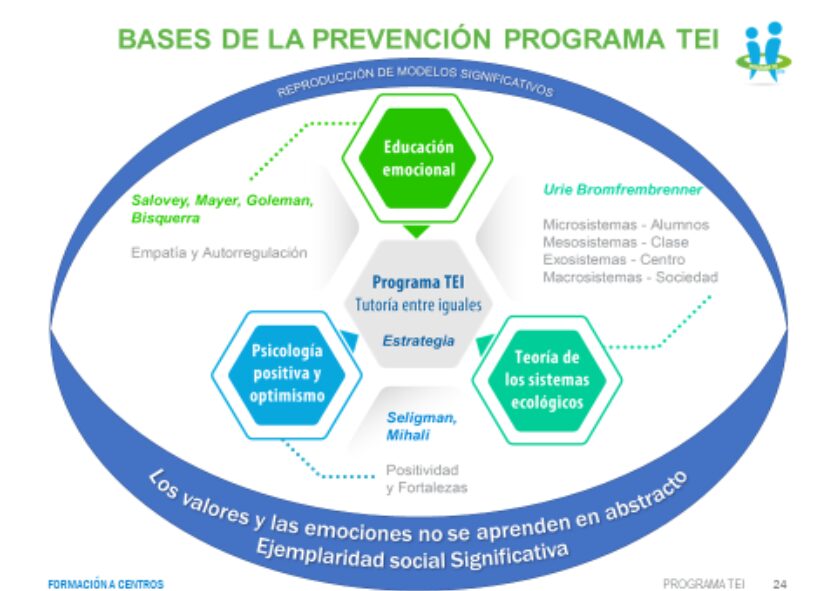
Source: Bellido, 2002, 2014, 2018
In these mediation/help systems between As peers, students participate from a neutral standpoint, seeking balance between the parties without offering value judgments or solutions. Furthermore, their position as equals translates into greater credibility among their classmates (Fernández, Villaoslada & Funes, 2002).
A example It is common for students to disagree on the distribution of tasks in a group project. If tension arises because some feel they are not being heard or that their work is not valued, peer tutoring can intervene to facilitate dialogue, help negotiate roles, and find mutually agreeable solutions. In this way, mediation skills are strengthened, and a more collaborative and respectful environment is created.
Would you like to dedicate yourself professionally to mediation or specialize in one of its branches? You've come to the right place. EIM We offer a wide variety of training courses to meet your most ambitious goals.